visitor maps

Translation-Traduction

Tuesday, May 8, 2012

How will verdict in Oracle-Google copyright case affect the search giant’s business?


May 8 (Bloomberg) -- A federal judge said Oracle Corp. can’t seek $1 billion in damages from Google Inc. for infringing copyrights when it developed Android software running on more than 300 million mobile devices because a jury couldn’t agree on whether it was “fair use.”

A jury in San Francisco yesterday found that Google, the largest Web-search provider, infringed Oracle’s copyrights for programming tools and nine lines of code. U.S. District Judge William Alsup said at this point Oracle can only seek damages on the nine lines, which by law would be at most $150,000.

“There has been zero finding of liability on copyright, the issue of fair use is still in play,” Alsup said about the 12-member jury’s decision on the programming tools. He ordered the patent phase of the case to begin today; damages will be taken up by the jury in the last phase of the eight-week trial.

Anyone can use copyrighted work without consent of the owner if it advances the public interest by adding something new or functional. Google attorney Robert Van Nest asked Alsup to declare a mistrial, saying the issue of whether the company is liable for infringement is directly linked to the question of whether it was fair use. Alsup gave each side until May 10 to submit arguments on that issue and didn’t say when he’ll rule.

“Google won the battle and it remains to be seen who won the war,” said Brian Love, an intellectual property attorney and teaching fellow at Stanford Law School.

Mobile Devices

Oracle alleged that Google, based in Mountain View, California, stole copyrights and patents for the Java programming language when it developed the Android operating system for mobile devices, which were released in 2007. Oracle acquired Java when it bought Sun Microsystems Inc. in 2010.

Oracle, the largest maker of database software, is seeking damages as well as a court order preventing Google from distributing Android unless it pays for a license.

“Oracle, the nine million Java developers, and the entire Java community thank the jury for their verdict in this phase of the case,” Deborah Hellinger, an Oracle spokeswoman, said in an e-mail. “The overwhelming evidence demonstrated that Google knew it needed a license.

‘‘Every major commercial enterprise -- except Google -- has a license for Java and maintains compatibility to run across all computing platforms,’’ she said.

Last Word

The jury’s findings may not be the last word on infringement. While the panel was asked to decide whether Google infringed parts of Java called application programming interfaces, or APIs, the ultimate decision on whether APIs are covered by copyrights will be made by Alsup later in the case. Alsup told the jury to assume APIs are copyrightable; he can decide later that they aren’t.

Alsup must also rule on Oracle’s request for a judgment in its favor that Google infringed Java copyrights and its copying wasn’t fair use. A ruling for Oracle could set aside the jury’s decision.

‘‘We appreciate the jury’s efforts, and know that fair use and infringement are two sides of the same coin,” Google spokesman Jim Prosser said in an e-mail. “The core issue is whether the APIs here are copyrightable, and that’s for the court to decide. We expect to prevail on this issue and Oracle’s other claims.”

Seven Notes

The jury found yesterday that Google didn’t infringe the documentation for the 37 APIs at issue. The panel also determined that Google infringed just 1 of 3 Java codes that were in dispute. In addition, jurors concluded that while Google proved that “Sun and/or Oracle” led the company to believe it didn’t need a license for the Java technology, Google didn’t show that it relied on that knowledge when it decided not to seek a license.

The verdict came on the fifth day of deliberations in the trial, which began April 16. The jury sent Alsup seven notes during its discussions with questions, including some about the meaning of “fair use.” A May 3 note said the panel couldn’t reach a unanimous decision. Alsup ordered jurors to continue deliberations, and after learning the panel was still at an impasse, ordered them to deliver a partial verdict.

Java is a free language. Oracle argued that the parts of Java that Google used are covered by copyrights and that the search engine company was required to pay for a license to use the technology.

Operating System

Google denied infringement, saying it developed Android from scratch and that the Java elements it used aren’t covered by copyrights. Any bits of copied Java in Android constituted fair use because Google gives Android away for free to programmers and it expanded the language’s usefulness by finding a way to build a smartphone operating system with Java, something Sun and Oracle were unable to do.

Oracle argued that the Java copying was for Google’s commercial benefit -- to increase use of Google’s search engine, which generates advertising revenue -- and added nothing new to Java.

The next phase of the case is about two Java patents Oracle alleges were infringed.

The case is Oracle v. Google, 10-3561, U.S. District Court, Northern District of California (San Francisco).

Google's driverless car now street legal in Nevada

The Google car that can drive itself is now eligible to ride on the streets of Nevada.

Technically speaking, what this means is that the car - yes, the car itself - has been issued its own driver license. In other words, the state of Nevada feels the inner workings of Google's smart vehicle contain the same capacity of driving ability and human judgment as any physical person sitting behind the wheel.

The car in question is a Prius, and has been loaded with a very special software package originally designed by Google for use in and around the company's headquarters in Mountain View, California.

But it is in Nevada where Google has been spending most of its time with the contraption as of late, since that's the state that it has been able to sweet talk into actually making it legal to take on the streets.

The software within the car uses all sorts of tools, ranging from a set of short-range radar sensors and video cameras to a persistent Internet connection that constantly scans Google Maps for road and traffic updates.

While obviously it is still a highly focused and experimental project, it could be the beginning of a ripple effect on the entire automotive industry.

Of course, Google hasn't really put the car through its full paces just yet. When it goes for a test drive, the car always has trained employees inside, who are able to override the autopilot mechanism at a moment's notice.

Interestingly enough, though, the only time that the driverless car has been in an accident is when it was being driven in manual override mode. It has never shown any safety problems when in its driverless state.

Friday, April 20, 2012

Home How To How to delete yourself from the Internet


You may not feel like the flotsam and jetsam that make up the facts of your life are important, but increasingly companies are using that dry data to make your every online step as indelible as if written in blood. Here's how to take back your digital dignity.

Seth Rosenblatt by Seth Rosenblatt   April 19, 2012 6:19 PM PDT

The Internet companies that power your online life know that data equals money, and they're becoming bolder about using that data to track you. If they get their way, your every online step would be not only irrevocable, but traceable back to you. Fortunately, there are some positive steps you can take to reclaim your online history for yourself.

The online privacy software company Abine, which makes Do Not Track Plus, also offers a service called DeleteMe, which removes your data from numerous tracking sites and keeps it from coming back. In an unusual gesture, though, they've made public how to do for yourself everything that DeleteMe does. Here's my take on their advice.

Be warned, though. The following are not easy instructions, and it's not because they're technically complex. They require a tenacity and wherewithal that is likely to either exhaust you, drive you borderline bonkers, or both. (And no, I haven't followed the instructions to remove myself because it's essential to my job that I can be found by strangers.)

Step 1: Prepare yourself: You're going to have to be polite.
These instructions require patience for the antics of others and determination to get the job done. It's not a bad idea to get something inanimate to take your frustrations out on, because often getting your data successfully removed or changed will require the good faith of the person you're dealing with. Things are not likely to go your way the first time around.

Step 2: Aggressively track sites that aggressively track you.
This is where the DeleteMe service comes in. They currently charge you $99 to un-track you from the tracking data clearinghouses, which in turn sell your data to others entities. You can follow Abine's list of services and do the deed yourself, and that means writing many e-mails, sending numerous faxes, and placing enough phone calls to make you wish for a time machine so you can go back to the 19th century to do violence unto Alexander Graham Bell.

One thing that isn't clear from Abine's list is that most of these data aggregators will re-add you within a few months, so I recommend at least bi-annual checks to see if they've sucked up your data again. Be tenacious, be polite, and if this is important to you, stick with it until you get what you want.

If you're concerned about privacy and people making connections between your birthday, your address, and your Social Security number, you owe it to yourself to perform at least one Web search for your name and see what comes up. You might be unpleasantly surprised.

Step 3: To protect your reputation, removal must be done from the source.
To get Google, Bing, and other search engines to notice a change in information as it is presented on the Web, the original site hosting that information must change. It doesn't matter which site is the source. It could be Facebook, or a local blog, or a gaming forum. If it's showing up in search results, it has little to do with the search engine and everything to do with the site of origin. Once that site has changed, then you'll see a change in the search results.

Getting something removed from a site is not a scientific process, even though you must be methodical about it. Ask politely, and as I noted above, you're likely to have to ask more than once and using more than one way to communicate. You likely will have to be a rake at the gates of Hell, but one that uses words like "please" and "thank you".

Look for the name of a writer, or Web site manager, and if no contact information is listed, do a WhoIs search by typing "whois www.site-name.com". Be sure to include the quotes. That will tell you who registered the site, which is a good place to start on smaller Web sites. Look for phone numbers, e-mail, and fax numbers, and follow up your initial communication.

Once you have a name, even if you can't find a phone number or e-mail, you can probably take an educated stab at one. Use a site like E-mail Format to help you out. And in your e-mail, be sure to explain clearly, concisely, and logically why your request ought to be honored.

A willingness to compromise can get you better results, too. If, for example, your initial request to fully remove your name gets refused, see if asking to have your identity anonymized will work. And if one person at the site you've contacted keeps stalling you, see if there's another you can contact instead.

Step 4: Get Google to hustle on search engine changes.
If you've been successful in changing a site, but Google is still showing the older version, you can use Google's URL Removal Tool to accelerate the process. Note that this will require a Google account, and that if you get Google to change, you're going to have to submit requests to other major search engines like Bing separately.

Step 5: Paint over the bad with good.
In cases where you can't get the site to remove the content that's negatively affecting your reputation, you can create new, fresh, positive content to counteract it. The idea is that the Positive You will bury the Negative You. Rick Santorum is a great example of how this can work in reverse, and no, I'm not going to link to it for you.

You can also use social-networking sites to bury bad news. From About.Me to Flickr to Twitter, social networks tend to rank highly in search results. By creating and maintaining accounts that use your real name, you can elevate the social networking results for your name and, ideally, drop the results you want to bury onto the second page of results. Since studies show that second-page results are viewed significantly less often than first-page, this could be a successful burying strategy.

However, a key component of this is linking the networks, so be prepared to do far more social networking than you had been.

Step 6: Go (politely) nuclear. Get a lawyer.
If you suspect something is actually defamatory, seek out legal advice. Gather your evidence, be polite and firm, and seek out someone who can guide you through the thorny legal thicket. This will also depend on your country -- England has much broader defamation and libel laws than the United States does -- and your budget.

There is no foolproof method for changing how you're presented on the Internet, whether looking at purely personally-identifiable data or the much more subjective presentation of your personal reputation. However, if these are concerns of yours, you're not alone out there, and these six steps will give you concrete actions you can take to reclaim your identity and repair how others see you.

Thursday, April 5, 2012

Hitachi Ultrastar 7K4000 4TB Enterprise Hard Drive Announced

Hitachi has announced their next generation enterprise hard drive, the Ultrastar 7K4000. The most obvious change is the 1TB capacity bump over the Ultrastar 7K3000, but this is no insignificant matter. The 33% capacity boost in the same 3.5" form factor gives enterprise users the opportunity to lower their cost/GB as the new Ultrastar 7K4000 hard drives can offer more capacity in the same footprint and weight profile, without increasing costs associated with power, data center cooling and the like. The Ultrastar 7K4000 is the first 4TB enterprise hard drive to ship, placing it alongside another first, the Hitachi Deskstar 5K4000, which is the first 4TB hard drive shipping for client use.

From a hardware perspective, the Ultrastar 7K4000 features a 7,200 RPM rotational speed, 64MB of drive cache and a SATA 6Gb/s interface; delivering up to 171 MB/s throughput in the five x 800GB platter design. The drive is Advanced Format, using 4096-byte sector size, but is backward compatible with legacy 512-byte sector size by offering built-in 512-byte emulation. With smaller steps in aerial density, moving to 512e Advanced Format lets Hitachi continue to drive progressive capacity bumps in the Ultrastar line. 

Of course Hitachi continues to offer an industry-leading five year standard warranty and a 2 million hour MTBF. 

Hitachi Ultrastar 7K4000 Specs

  • Capacities
    • 4TB - HUS724040ALE640
    • 3TB - HUS724030ALE640
    • 2TB - HUS724020ALE640
  • Interface - SATA 6Gb/s
  • Form Factor - 3.5-inch
  • Sector size - 512e
  • Max. areal density (Gbits/sq. in) - 446
  • Data buffer - 64MB
  • Rotational speed (RPM) - 7200
  • Sustained transfer rate (typical) - 171 MB/s
  • Seek time (read, typical) - 8.0ms
  • Error rate (non-recoverable, bits read) - 1 in 1015
  • Load/unload cycles (at 40° C) - 600,000
  • Targeted MTBF - 2 million hours
  • Warranty - 5 years
  • Acoustics Idle (Bels, typical) - 2.9
  • Startup current (A, max) - 1.2 (+5V), 2.0 (+12V)
  • Read/write (W) - 11.4
  • Unload idle (W) - 5.7
  • Weight (typical) - 690g
  • Environmental (operating) ambient temperature - 5 to 60C
  • Shock (half-sine wave 2 ms) - 70G
  • Vibration, random (G RMS 5 to 500 Hz) - 0.67 (XYZ)
  • Environmental (non-operating) Ambient temperature: -40 to 70C
  • Shock (half-sine wave 1ms) - 300G

Availability

The Hitachi Ultrastar 7K4000 family is now shipping in limited quantities in 2TB, 3TB and 4TB capacities. 

Sunday, March 11, 2012

Morocco’s main telecom provider blocks access to Skype and other VoIP services


skype-office-design-6

According to Moroccan Blog, Moroccan Geeks [French], Skype and all other VoIP services have been blocked in the country, pointing to an article from Moroccan newspaper Al Sabaheya confirming the news [Arabic].

While services are more often than not blocked as a result of authoritative governments, Skype usually finds itself targeted by mobile operators and telecom providers, as was the case for Skype itself in Egypt. In Morocco, it would appear the move has been made in an attempt to create a monopoly on calling options available in the country.

According to Moroccan Geeks, Skype is a popular mode of communication in the country, adding that it, along with other VoIP services including TeamSpeak and Viber have also been affected by the block.

The blog goes on to say that the telecom provider is “protecting itself against competition, pushing customers to use its own services instead of free services like Skype, TeamSpeak or Viber.”

According to the newspaper, Al Sabaheya, the move comes at a time when Maroc Telecom is promoting its own VoIP service, MTBOX.

Over the past few months, accessing Skype in Morocco has proved difficult, with complaints of poor call quality and dropped calls, and at the time, users speculated whether it was an intentional move on the part of Maroc Telecom.

With the latest blog posts, tweets and Facebook posts, coming out of Morocco, it’s safe to assume that Skype and other VoIP services are no longer welcome on Maroc Telecom’s network.

Wednesday, December 14, 2011

Finally, A Rich American Destroys The Fiction That Rich People Create The Jobs

Henry Blodget | Dec. 12, 2011, 10:38 AM | 187,589 | 444

60 minutes child homelessness truck

Image: 60 Minutes

America's real job-creators...who can't afford to create any jobs.

In the war of rhetoric that has developed in Washington as both sides blame each other for our economic mess, one argument has been repeated so often that many people now regard it as fact:

Rich people create the jobs.

Specifically, entrepreneurs and investors, when incented by low taxes, build companies and create millions of jobs.

And these entrepreneurs and investors, therefore, the argument goes, can solve our nation's huge unemployment problem — if only we cut taxes and regulations so they can be incented to build more companies and create more jobs.

In other words, by even considering raising taxes on "the 1%," we are considering destroying the very mechanism that makes our economy the strongest and biggest in the world: The incentive for entrepreneurs nd investors to build companies in the hope of getting rich and, in the process, creating millions of jobs.

Now, there have long been many problems with this argument starting with

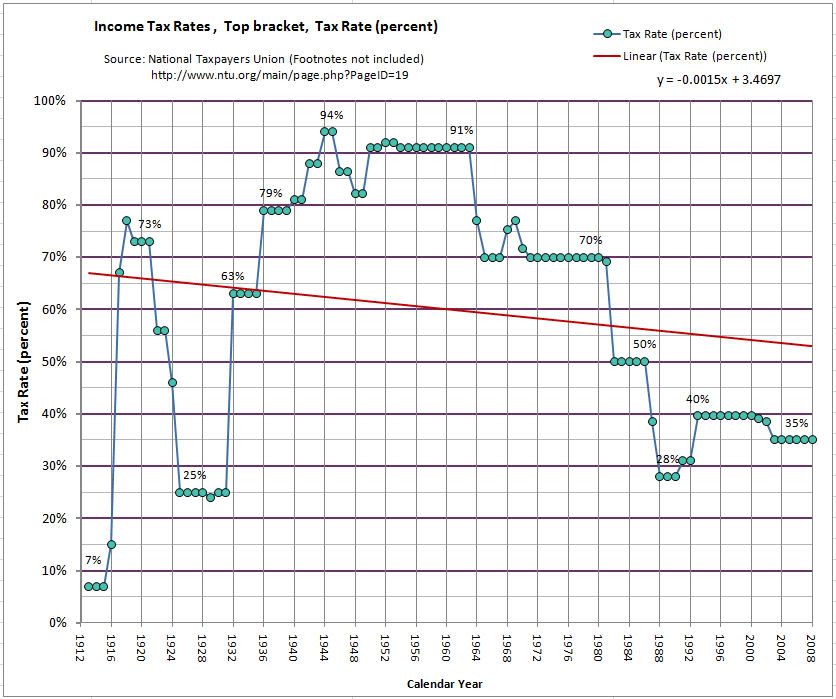
  1. Taxes on rich people (capital gains and income) are, relative to history, low, so raising them would only begin to bring them back in line with prior prosperous periods, and
  2. Dozens of rich entrepreneurs have already gone on record confirming that a modest hike in capital gains and income taxes would not have the slightest impact on their desire to create companies and jobs, given that tax rates are historically low.

So this argument, which many people regard as fact, is already flawed.

But now a super-rich and super-successful American has explained the most important reason the theory is absurd, while calling for higher taxes on himself and people like him.

US Income Tax Top Bracket

Image: National Taxpayers Union

THE TRUTH ABOUT TAX RATES: Click to see how low today's really are.

The most important reason the theory that "rich people create the jobs" is absurd, argues Nick Hanauer, the founder of online advertising company aQuantive, which Microsoft bought for $6.4 billion, is that rich people do not create jobs, even if they found and build companies that eventually employ thousands of people.

What creates the jobs, Hanauer astutely observes, is a healthy economic ecosystem surrounding the company, which starts with the company's customers.

The company's customers buy the company's products, which, in turn, creates the need for the employees to produce, sell, and service those products. If those customers go broke, the demand for the company's products will collapse. And the jobs will disappear, regardless of what the entrepreneur does.

Now, of course entrepreneurs are an important part of the company-creation process. And so are investors, who risk capital in the hope of earning returns. But, ultimately, whether a new company continues growing and creates self-sustaining jobs is a function of customers' ability and willingness to pay for the company's products, not the entrepreneur or the investor capital. Suggesting that "rich entrepreneurs and investors" create the jobs, therefore, Hanauer observes, is like suggesting that squirrels create evolution.

(Or, to put it even more simply, it's like saying that a seed creates a tree. The seed does not create the tree. The seed starts the tree. But what creates the tree is the combination of the DNA in the seed and the soil, sunshine, water, atmosphere, nutrients, and other factors that nurture it. Plant the seed in an inhospitable environment, and it won't create anything. It will die.)

So, then, if what creates the jobs in our economy is, in part, "customers," who are these customers? And what can government policy do to make sure these customers have more money to spend to create demand and, thus, jobs?

The customers of most companies, Hanauer points out, are ultimately the gigantic middle class — the hundreds of millions of Americans who currently take home a much smaller share of the national income than they did 30 years ago, before tax policy aimed at helping rich people get richer created an extreme of income and wealth inequality not seen since the 1920s.

50s housewife

She'd like to create jobs. But she can't afford to anymore. Click to see how extreme inequality has gotten.

The middle class has been pummeled, in part, by tax policies that reward "the 1%" at the expense of everyone else. 

(It has also been pummeled by globalization and technology improvements, which are largely outside of any one country's control.)

But, wait, aren't the huge pots of gold taken home by "the 1%" supposed to "trickle down" to the middle class and thus benefit everyone? Isn't that the way it's supposed to work?

Yes, that's the way it's supposed to work.

Unfortunately, that's not the way it actually works.

And Hanauer explains why.

Hanauer takes home more than $10 million a year of income. On this income, he says, he pays an 11% tax rate. (Presumably, most of the income is dividends and long-term capital gains, which carry a tax rate of 15%. And then he probably has some tax shelters that knock the rate down the rest of the way).

With the more than $9 million a year Hanauer keeps, he buys lots of stuff. But, importantly, he doesn't buy as much stuff as would be bought if that $9 million were instead earned by 9,000 Americans each taking home an extra $1,000 a year.

Why not?

Because, despite Hanauer's impressive lifestyle — his family owns a plane — most of the $9+ million just goes straight into the bank (where it either sits and earns interest or gets invested in companies that ultimately need strong demand to sell products and create jobs). For a specific example, Hanauer points out that his family owns 3 cars, not the 3,000 that might be bought if his $9+ million were taken home by a few thousand families.

If that $9+ million had gone to 9,000 families instead of Hanauer, it would almost certainly have been pumped right back into the economy via consumption (i.e., demand). And, in so doing, it would have created more jobs.

Hanauer estimates that, if most American families were taking home the same share of the national income that they were taking home 30 years ago, every family would have another $10,000 of disposable income to spend.

That, Hanauer points out, would have a huge impact on demand — and, thereby job creation.

It's time we stopped mouthing the fiction that "rich people create the jobs."

Rich people don't create the jobs.

Our economy creates jobs.

We're all in this together. And until we return to more reasonable tax policies that help the 99% instead of just the 1%, our economy is going to go nowhere.

Clubic.com - Articles / Tests / Dossiers