visitor maps

Translation-Traduction

Friday, April 20, 2012

Home How To How to delete yourself from the Internet


You may not feel like the flotsam and jetsam that make up the facts of your life are important, but increasingly companies are using that dry data to make your every online step as indelible as if written in blood. Here's how to take back your digital dignity.

Seth Rosenblatt by Seth Rosenblatt   April 19, 2012 6:19 PM PDT

The Internet companies that power your online life know that data equals money, and they're becoming bolder about using that data to track you. If they get their way, your every online step would be not only irrevocable, but traceable back to you. Fortunately, there are some positive steps you can take to reclaim your online history for yourself.

The online privacy software company Abine, which makes Do Not Track Plus, also offers a service called DeleteMe, which removes your data from numerous tracking sites and keeps it from coming back. In an unusual gesture, though, they've made public how to do for yourself everything that DeleteMe does. Here's my take on their advice.

Be warned, though. The following are not easy instructions, and it's not because they're technically complex. They require a tenacity and wherewithal that is likely to either exhaust you, drive you borderline bonkers, or both. (And no, I haven't followed the instructions to remove myself because it's essential to my job that I can be found by strangers.)

Step 1: Prepare yourself: You're going to have to be polite.
These instructions require patience for the antics of others and determination to get the job done. It's not a bad idea to get something inanimate to take your frustrations out on, because often getting your data successfully removed or changed will require the good faith of the person you're dealing with. Things are not likely to go your way the first time around.

Step 2: Aggressively track sites that aggressively track you.
This is where the DeleteMe service comes in. They currently charge you $99 to un-track you from the tracking data clearinghouses, which in turn sell your data to others entities. You can follow Abine's list of services and do the deed yourself, and that means writing many e-mails, sending numerous faxes, and placing enough phone calls to make you wish for a time machine so you can go back to the 19th century to do violence unto Alexander Graham Bell.

One thing that isn't clear from Abine's list is that most of these data aggregators will re-add you within a few months, so I recommend at least bi-annual checks to see if they've sucked up your data again. Be tenacious, be polite, and if this is important to you, stick with it until you get what you want.

If you're concerned about privacy and people making connections between your birthday, your address, and your Social Security number, you owe it to yourself to perform at least one Web search for your name and see what comes up. You might be unpleasantly surprised.

Step 3: To protect your reputation, removal must be done from the source.
To get Google, Bing, and other search engines to notice a change in information as it is presented on the Web, the original site hosting that information must change. It doesn't matter which site is the source. It could be Facebook, or a local blog, or a gaming forum. If it's showing up in search results, it has little to do with the search engine and everything to do with the site of origin. Once that site has changed, then you'll see a change in the search results.

Getting something removed from a site is not a scientific process, even though you must be methodical about it. Ask politely, and as I noted above, you're likely to have to ask more than once and using more than one way to communicate. You likely will have to be a rake at the gates of Hell, but one that uses words like "please" and "thank you".

Look for the name of a writer, or Web site manager, and if no contact information is listed, do a WhoIs search by typing "whois www.site-name.com". Be sure to include the quotes. That will tell you who registered the site, which is a good place to start on smaller Web sites. Look for phone numbers, e-mail, and fax numbers, and follow up your initial communication.

Once you have a name, even if you can't find a phone number or e-mail, you can probably take an educated stab at one. Use a site like E-mail Format to help you out. And in your e-mail, be sure to explain clearly, concisely, and logically why your request ought to be honored.

A willingness to compromise can get you better results, too. If, for example, your initial request to fully remove your name gets refused, see if asking to have your identity anonymized will work. And if one person at the site you've contacted keeps stalling you, see if there's another you can contact instead.

Step 4: Get Google to hustle on search engine changes.
If you've been successful in changing a site, but Google is still showing the older version, you can use Google's URL Removal Tool to accelerate the process. Note that this will require a Google account, and that if you get Google to change, you're going to have to submit requests to other major search engines like Bing separately.

Step 5: Paint over the bad with good.
In cases where you can't get the site to remove the content that's negatively affecting your reputation, you can create new, fresh, positive content to counteract it. The idea is that the Positive You will bury the Negative You. Rick Santorum is a great example of how this can work in reverse, and no, I'm not going to link to it for you.

You can also use social-networking sites to bury bad news. From About.Me to Flickr to Twitter, social networks tend to rank highly in search results. By creating and maintaining accounts that use your real name, you can elevate the social networking results for your name and, ideally, drop the results you want to bury onto the second page of results. Since studies show that second-page results are viewed significantly less often than first-page, this could be a successful burying strategy.

However, a key component of this is linking the networks, so be prepared to do far more social networking than you had been.

Step 6: Go (politely) nuclear. Get a lawyer.
If you suspect something is actually defamatory, seek out legal advice. Gather your evidence, be polite and firm, and seek out someone who can guide you through the thorny legal thicket. This will also depend on your country -- England has much broader defamation and libel laws than the United States does -- and your budget.

There is no foolproof method for changing how you're presented on the Internet, whether looking at purely personally-identifiable data or the much more subjective presentation of your personal reputation. However, if these are concerns of yours, you're not alone out there, and these six steps will give you concrete actions you can take to reclaim your identity and repair how others see you.

Thursday, April 5, 2012

Hitachi Ultrastar 7K4000 4TB Enterprise Hard Drive Announced

Hitachi has announced their next generation enterprise hard drive, the Ultrastar 7K4000. The most obvious change is the 1TB capacity bump over the Ultrastar 7K3000, but this is no insignificant matter. The 33% capacity boost in the same 3.5" form factor gives enterprise users the opportunity to lower their cost/GB as the new Ultrastar 7K4000 hard drives can offer more capacity in the same footprint and weight profile, without increasing costs associated with power, data center cooling and the like. The Ultrastar 7K4000 is the first 4TB enterprise hard drive to ship, placing it alongside another first, the Hitachi Deskstar 5K4000, which is the first 4TB hard drive shipping for client use.

From a hardware perspective, the Ultrastar 7K4000 features a 7,200 RPM rotational speed, 64MB of drive cache and a SATA 6Gb/s interface; delivering up to 171 MB/s throughput in the five x 800GB platter design. The drive is Advanced Format, using 4096-byte sector size, but is backward compatible with legacy 512-byte sector size by offering built-in 512-byte emulation. With smaller steps in aerial density, moving to 512e Advanced Format lets Hitachi continue to drive progressive capacity bumps in the Ultrastar line. 

Of course Hitachi continues to offer an industry-leading five year standard warranty and a 2 million hour MTBF. 

Hitachi Ultrastar 7K4000 Specs

  • Capacities
    • 4TB - HUS724040ALE640
    • 3TB - HUS724030ALE640
    • 2TB - HUS724020ALE640
  • Interface - SATA 6Gb/s
  • Form Factor - 3.5-inch
  • Sector size - 512e
  • Max. areal density (Gbits/sq. in) - 446
  • Data buffer - 64MB
  • Rotational speed (RPM) - 7200
  • Sustained transfer rate (typical) - 171 MB/s
  • Seek time (read, typical) - 8.0ms
  • Error rate (non-recoverable, bits read) - 1 in 1015
  • Load/unload cycles (at 40° C) - 600,000
  • Targeted MTBF - 2 million hours
  • Warranty - 5 years
  • Acoustics Idle (Bels, typical) - 2.9
  • Startup current (A, max) - 1.2 (+5V), 2.0 (+12V)
  • Read/write (W) - 11.4
  • Unload idle (W) - 5.7
  • Weight (typical) - 690g
  • Environmental (operating) ambient temperature - 5 to 60C
  • Shock (half-sine wave 2 ms) - 70G
  • Vibration, random (G RMS 5 to 500 Hz) - 0.67 (XYZ)
  • Environmental (non-operating) Ambient temperature: -40 to 70C
  • Shock (half-sine wave 1ms) - 300G

Availability

The Hitachi Ultrastar 7K4000 family is now shipping in limited quantities in 2TB, 3TB and 4TB capacities. 

Sunday, March 11, 2012

Morocco’s main telecom provider blocks access to Skype and other VoIP services


skype-office-design-6

According to Moroccan Blog, Moroccan Geeks [French], Skype and all other VoIP services have been blocked in the country, pointing to an article from Moroccan newspaper Al Sabaheya confirming the news [Arabic].

While services are more often than not blocked as a result of authoritative governments, Skype usually finds itself targeted by mobile operators and telecom providers, as was the case for Skype itself in Egypt. In Morocco, it would appear the move has been made in an attempt to create a monopoly on calling options available in the country.

According to Moroccan Geeks, Skype is a popular mode of communication in the country, adding that it, along with other VoIP services including TeamSpeak and Viber have also been affected by the block.

The blog goes on to say that the telecom provider is “protecting itself against competition, pushing customers to use its own services instead of free services like Skype, TeamSpeak or Viber.”

According to the newspaper, Al Sabaheya, the move comes at a time when Maroc Telecom is promoting its own VoIP service, MTBOX.

Over the past few months, accessing Skype in Morocco has proved difficult, with complaints of poor call quality and dropped calls, and at the time, users speculated whether it was an intentional move on the part of Maroc Telecom.

With the latest blog posts, tweets and Facebook posts, coming out of Morocco, it’s safe to assume that Skype and other VoIP services are no longer welcome on Maroc Telecom’s network.

Wednesday, December 14, 2011

Finally, A Rich American Destroys The Fiction That Rich People Create The Jobs

Henry Blodget | Dec. 12, 2011, 10:38 AM | 187,589 | 444

60 minutes child homelessness truck

Image: 60 Minutes

America's real job-creators...who can't afford to create any jobs.

In the war of rhetoric that has developed in Washington as both sides blame each other for our economic mess, one argument has been repeated so often that many people now regard it as fact:

Rich people create the jobs.

Specifically, entrepreneurs and investors, when incented by low taxes, build companies and create millions of jobs.

And these entrepreneurs and investors, therefore, the argument goes, can solve our nation's huge unemployment problem — if only we cut taxes and regulations so they can be incented to build more companies and create more jobs.

In other words, by even considering raising taxes on "the 1%," we are considering destroying the very mechanism that makes our economy the strongest and biggest in the world: The incentive for entrepreneurs nd investors to build companies in the hope of getting rich and, in the process, creating millions of jobs.

Now, there have long been many problems with this argument starting with

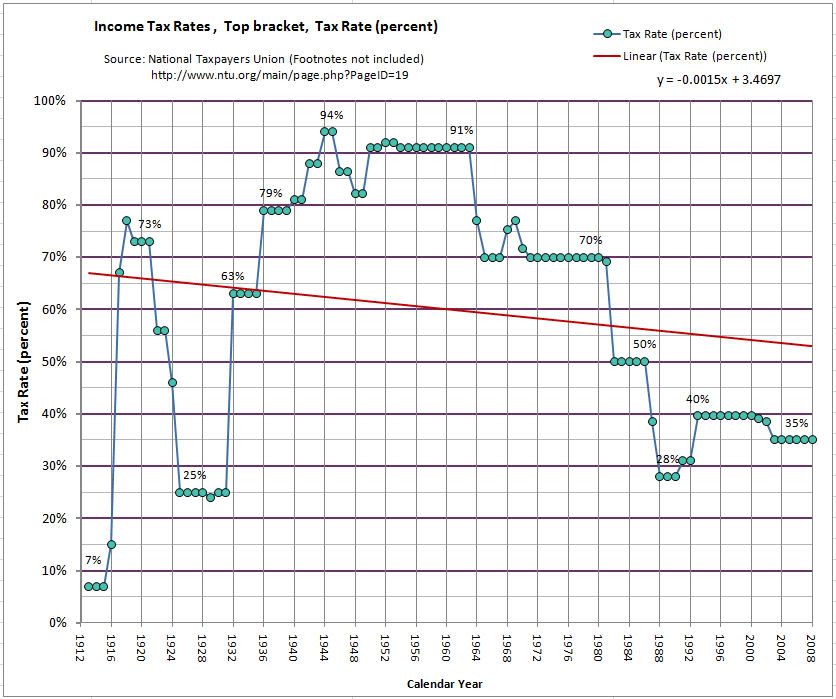
  1. Taxes on rich people (capital gains and income) are, relative to history, low, so raising them would only begin to bring them back in line with prior prosperous periods, and
  2. Dozens of rich entrepreneurs have already gone on record confirming that a modest hike in capital gains and income taxes would not have the slightest impact on their desire to create companies and jobs, given that tax rates are historically low.

So this argument, which many people regard as fact, is already flawed.

But now a super-rich and super-successful American has explained the most important reason the theory is absurd, while calling for higher taxes on himself and people like him.

US Income Tax Top Bracket

Image: National Taxpayers Union

THE TRUTH ABOUT TAX RATES: Click to see how low today's really are.

The most important reason the theory that "rich people create the jobs" is absurd, argues Nick Hanauer, the founder of online advertising company aQuantive, which Microsoft bought for $6.4 billion, is that rich people do not create jobs, even if they found and build companies that eventually employ thousands of people.

What creates the jobs, Hanauer astutely observes, is a healthy economic ecosystem surrounding the company, which starts with the company's customers.

The company's customers buy the company's products, which, in turn, creates the need for the employees to produce, sell, and service those products. If those customers go broke, the demand for the company's products will collapse. And the jobs will disappear, regardless of what the entrepreneur does.

Now, of course entrepreneurs are an important part of the company-creation process. And so are investors, who risk capital in the hope of earning returns. But, ultimately, whether a new company continues growing and creates self-sustaining jobs is a function of customers' ability and willingness to pay for the company's products, not the entrepreneur or the investor capital. Suggesting that "rich entrepreneurs and investors" create the jobs, therefore, Hanauer observes, is like suggesting that squirrels create evolution.

(Or, to put it even more simply, it's like saying that a seed creates a tree. The seed does not create the tree. The seed starts the tree. But what creates the tree is the combination of the DNA in the seed and the soil, sunshine, water, atmosphere, nutrients, and other factors that nurture it. Plant the seed in an inhospitable environment, and it won't create anything. It will die.)

So, then, if what creates the jobs in our economy is, in part, "customers," who are these customers? And what can government policy do to make sure these customers have more money to spend to create demand and, thus, jobs?

The customers of most companies, Hanauer points out, are ultimately the gigantic middle class — the hundreds of millions of Americans who currently take home a much smaller share of the national income than they did 30 years ago, before tax policy aimed at helping rich people get richer created an extreme of income and wealth inequality not seen since the 1920s.

50s housewife

She'd like to create jobs. But she can't afford to anymore. Click to see how extreme inequality has gotten.

The middle class has been pummeled, in part, by tax policies that reward "the 1%" at the expense of everyone else. 

(It has also been pummeled by globalization and technology improvements, which are largely outside of any one country's control.)

But, wait, aren't the huge pots of gold taken home by "the 1%" supposed to "trickle down" to the middle class and thus benefit everyone? Isn't that the way it's supposed to work?

Yes, that's the way it's supposed to work.

Unfortunately, that's not the way it actually works.

And Hanauer explains why.

Hanauer takes home more than $10 million a year of income. On this income, he says, he pays an 11% tax rate. (Presumably, most of the income is dividends and long-term capital gains, which carry a tax rate of 15%. And then he probably has some tax shelters that knock the rate down the rest of the way).

With the more than $9 million a year Hanauer keeps, he buys lots of stuff. But, importantly, he doesn't buy as much stuff as would be bought if that $9 million were instead earned by 9,000 Americans each taking home an extra $1,000 a year.

Why not?

Because, despite Hanauer's impressive lifestyle — his family owns a plane — most of the $9+ million just goes straight into the bank (where it either sits and earns interest or gets invested in companies that ultimately need strong demand to sell products and create jobs). For a specific example, Hanauer points out that his family owns 3 cars, not the 3,000 that might be bought if his $9+ million were taken home by a few thousand families.

If that $9+ million had gone to 9,000 families instead of Hanauer, it would almost certainly have been pumped right back into the economy via consumption (i.e., demand). And, in so doing, it would have created more jobs.

Hanauer estimates that, if most American families were taking home the same share of the national income that they were taking home 30 years ago, every family would have another $10,000 of disposable income to spend.

That, Hanauer points out, would have a huge impact on demand — and, thereby job creation.

It's time we stopped mouthing the fiction that "rich people create the jobs."

Rich people don't create the jobs.

Our economy creates jobs.

We're all in this together. And until we return to more reasonable tax policies that help the 99% instead of just the 1%, our economy is going to go nowhere.

Thursday, November 3, 2011

Al-Jazeera et le triomphe de la propagande télévisuelle

Al-Jazeera, la chaîne d’information qatariote qui s’est imposée en 15 ans dans le monde arabe comme une source originale d’information, s’est soudainement engagée dans une vaste opération d’intoxication visant à renverser les régimes libyen et syrien par tous les moyens. Ce revirement, démontre Thierry Meyssan, n’est pas le fruit de la conjoncture, mais a été préparé de longue date par des personnalités qui ont su cacher leurs intérêts personnels au grand public. Révélations...

La chaîne qatariote Al-Jazeera a annoncé la démission de son directeur général, Wadah Khanfar, et son remplacement par un membre de la famille royale, cheikh Hamad Ben Jassem Al-Thani, le 20 septembre 2011.
Cheikh Hamad est un cadre de Qatargas. Il a travaillé pendant un an à Paris-La Défense au siège de Total. Il présidait par le passé le Conseil d’administration d’Al-Jazeera.
Cette nouvelle est présentée dans la presse atlantiste de trois manières différentes : soit comme une démission forcée et une reprise en main de la chaîne par l’État, soit comme une vengeance de l’Autorité palestinienne après la diffusion des Palestinian Papers, soit enfin comme une conséquence des fuites de Wikileaks exposant certaines des connexions de M. Khanfar avec les États-Unis.
Si toutes ces interprétations peuvent contenir une part de vérité elles masquent la raison principale : le rôle du Qatar dans la guerre contre la Libye. Ici, un retour en arrière est nécessaire.

L’origine d’Al-Jazeera : une volonté de dialogue

Al-Jazeera a été conçu par deux personnalités franco-israéliennes, les frères David et Jean Frydman, après l’assassinat de Yitzhak Rabin, dont ils étaient proches. Selon David Frydman [1], l’objectif était de créer un média où des Israéliens et des Arabes pourraient débattre librement, échanger des arguments, et apprendre à se connaître, alors que ceci était interdit par la situation de guerre et bloquait toute perspective de paix.
Pour créer la chaîne, les frères Frydman bénéficièrent d’un concours de circonstances : la compagnie saoudienne Orbit avait conclu un accord avec la BBC pour créer un journal télévisé en arabe. Mais les exigences politiques de la monarchie absolue saoudienne se révélèrent vite incompatibles avec la liberté de travail des journalistes britanniques. L’accord fut résilié et la majorité des journalistes arabisants de la BBC se retrouvèrent au chômage. Ils furent donc récupérés pour fonder Al-Jazeera.
Les frères Frydman tenaient à ce que leur télévision soit perçue comme une chaîne arabe. Ils parvinrent à convaincre le nouvel émir de Qatar, Hamid bin Khalifa al-Thani, qui, avec l’aide de Londres et de Washington, venait de renverser son père —accusé de sentiments pro-Iraniens—. Cheikh Hamad bin-Khalifa comprit rapidement les avantages qu’il pouvait tirer à se trouver au centre des discussions israélo-arabes, qui duraient depuis un demi-siècle déjà et s’annonçaient encore longues. Au passage, il autorisa l’ouverture à Doha d’un bureau du ministère israélien du Commerce, à défaut de pouvoir ouvrir une ambassade. Surtout, il vit l’intérêt pour le Qatar de concurrencer les riches médias saoudiens pan-arabes et de disposer d’un média qui critique tout le monde, sauf lui.
Le montage financier initial prévoyait à la fois une mise de fonds des frères Frydman et un prêt de l’émir de 150 millions de dollars sur 5 ans. C’est le boycott des annonceurs organisé par l’Arabie saoudite et l’absence de revenus significatifs de la publicité qui a conduit à modifier le schéma initial. En définitive, l’émir est devenu le bailleur de fonds de la chaîne et donc son commanditaire.

Des journalistes exemplaires

Durant des années, l’audience d’Al-Jazeera a été tirée par son pluralisme interne. La chaîne s’enorgueillissait de laisser dire une chose et son contraire. Sa prétention n’était pas de dire la vérité, mais de la faire surgir du débat. Son émission phare, le talk show de l’iconoclaste Faisal al-Qassem, intitulé « L’Opinion contraire », se régalait à bousculer les préjugés. Chacun pouvait trouver des motifs de se réjouir de certains programmes et d’en déplorer d’autres. Peu importe, ce bouillonnement interne a eu raison du monolithisme de ses concurrents et a bouleversé le paysage audio-visuel arabe.
Le rôle héroïque des reporters d’Al-Jazeera en Afghanistan et durant la troisième guerre du Golfe, en 2003, et leur travail exemplaire contrastant avec la propagande des chaînes satellitaires pro-US, transforma l’image de la chaîne d’une station polémique en média de référence. Ses journalistes payèrent au prix fort leur courage : George W. Bush hésita à bombarder les studio de Doha, mais fit assassiner Tareq Ayyoub [2], arrêter Tayseer Alouni [3] et incarcérer Sami el-Hajj à Guantanamo [4].

La réorganisation de 2005

Cependant les meilleures choses ont une fin. En 2004-05, après le décès de David Frydman, l’émir décida de réorganiser complètement Al-Jazeera et de créer de nouveaux canaux, dont Al-Jazeera English, alors que le marché mondial se transformait et que tous les grands États se dotaient de chaînes d’information satellitaires. Il s’agissait clairement d’abandonner l’effervescence et les provocations du début, de capitaliser une audience atteignant désormais les 50 millions de téléspectateurs, pour se positionner comme un acteur du monde globalisé.
Cheikh Hamad bin-Khalifa(photo) fit appel à un cabinet international qui lui avait dispensé une formation personnelle en communication. JTrack s’était spécialisé dans l’entraînement des leaders arabes et d’Asie du Sud-Est pour leur apprendre à parler le langage de Davos : comment donner aux Occidentaux l’image qu’ils ont envie de voir. Du Maroc à Singapour, JTrack a ainsi formé la plupart des responsables politiques soutenus par les États-Unis et Israël —souvent de simples fantoches héréditaires— pour en faire des personnalités médiatiquement respectables. L’important n’est pas qu’ils aient quelque chose à dire, mais qu’ils sachent manier la langue de bois globale.
Toutefois, le Pdg de JTrack, ayant été appelé à de hautes fonctions gouvernementales en Afrique du Nord, il dût se retirer avant d’avoir achevé la transformation du Al-Jazeera Group. Il confia la suite des opérations à un ancien journaliste de Voice of America qui travaillait depuis plusieurs années déjà pour la chaîne qatariote et appartenait à la même confrérie musulmane que lui : Wadah Khanfar.
À la fois professionnellement compétent et politiquement sûr, M. Khanfar s’attacha à donner une couleur idéologique à Al-Jazeera. Tout en donnant la parole à Mohamed Hassanein Heikal, l’ancien porte-parole de Nasser, il fit de cheikh Yusuf al-Qaradawi —qui avait été déchu de sa nationalité égyptienne par Nasser— le « conseiller spirituel » de la chaîne.

Le virage de 2011

C’est avec les révolutions en Afrique du Nord et dans la péninsule arabique que Wadah Khanfar a brutalement modifié la ligne éditoriale de sa rédaction. Le Groupe a joué un rôle central dans l’accréditation du mythe du « printemps arabe » : les peuples, avides de vivre à l’occidentale, se seraient soulevés pour renverser des dictateurs et adopter des démocraties parlementaires. Rien ne distinguerait les événements de Tunisie et d’Égypte, de ceux de Libye et de Syrie. Quant aux mouvements du Yémen et de Bahreïn, ils n’intéresseraient pas les téléspectateurs.
En réalité, les Anglo-Saxons se sont efforcés de surfer sur des révoltes populaires pour rejouer le vieil air du « printemps arabe » qu’ils avaient organisé dans les années 1920 pour s’emparer des anciennes provinces ottomanes et y installer des démocraties parlementaires fantoches sous contrôle mandataire. Al-Jazeera a donc accompagné les révoltes tunisienne et égyptienne pour écarter la tentation révolutionnaire et légitimer de nouveaux gouvernements favorables aux États-Unis et à Israël. En Égypte, il s’est même agi d’une véritable récupération au profit d’une seule composante de la contestation : les Frères musulmans, représentés par le prêcheur star de la chaîne… cheikh Yusuf al-Qaradawi.
Indignés par cette nouvelle ligne éditoriale et par le recours de plus en plus fréquent au mensonge [5], certains journalistes comme Ghassan Ben Jedo claquent la porte.

Qui tire les ficelles de l’info ?
Quoi qu’il en soit, il faut attendre l’épisode libyen pour que les masques tombent. En effet, le patron de JTrack et mentor de Wadah Kanfhar n’est autre que Mahmoud Jibril (le "J" de "JTrack", c’est "Jibril"). Ce manager aimable, brillant et creux, avait été conseillé à Mouammar Kadhafi par ses nouveaux amis états-uniens pour piloter l’ouverture économique de la Libye après la normalisation de ses relations diplomatiques. Sous le contrôle de Saif el-Islam Kadhafi, il avait été nommé à la fois ministre du Plan et directeur de l’Autorité de développement, devenant de facto le numéro 2 du gouvernement, et ayant autorité sur les autres ministres. Il mena au pas de charge la dérégulation de cette économie socialiste et la privatisation de ses entreprises publiques.
À travers l’activité de formation de JTrack, Mahmoud Jibril avait noué des relations personnelles avec presque tous les dirigeants arabes et d’Asie du Sud-Est. Il disposait de bureaux à Bahreïn et à Singapour. M. Jibril avait aussi créé des sociétés de négoce, dont une chargée du commerce du bois de Malaisie et d’Australie avec son ami français Bernard-Henri Lévy.
Mahmoud Jibril(photo) avait suivi ses premières études universitaires au Caire. Il y avait fait la connaissance de la fille d’un des ministres de Nasser et l’avait épousée. Il avait poursuivi ses études aux États-Unis, où il avait adopté les thèses libertariennes qu’il essaya d’introduire dans l’idéologie anarchiste d’el-Kadhafi. Surtout, M. Jibril avait rejoint la confrérie des Frères musulmans en Libye. C’est à ce titre qu’il avait placé les Frères Wadah Kanfhar et Yusuf al-Qaradawi à Al-Jazeera.
Durant le premier semestre 2011, la chaîne qatariote est devenue l’instrument privilégié de la propagande pro-occidentale : elle a nié autant que possible l’aspect anti-impérialiste et anti-sioniste des révolutions arabes et a choisi dans chaque pays les protagonistes qu’elle soutenait et ceux qu’elle conspuait. Sans surprise, elle a soutenu le roi de Bahreïn —un élève de Mahmoud Jibril— qui faisait tirer sur la foule, tandis que cheikh al-Qaradawi appelait à l’antenne au Jihad contre el-Khadafi et el-Assad, accusés mensongèrement de massacrer leur propre peuple.
M. Jibril étant devenu le Premier ministre du gouvernement rebelle libyen, le sommet de la mauvaise foi aura été atteint avec la construction dans des studios à Doha de répliques de la Place verte et de Bab el-Azizia où furent tournées de fausses images de l’entrée des « rebelles » pro-Us dans Tripoli. Que n’ai-je lu comme insultes lorsque j’ai annoncé cette manipulation dans les colonnes de Voltairenet.org ! Pourtant Al-Jazeera et Sky News diffusèrent ces fausses images le second jour de la bataille de Tripoli, semant le désarroi parmi la population libyenne. Ce ne fut en réalité que trois jours plus tard que les « rebelles » —presque exclusivement les Misrata— entrèrent dans Tripoli dévastée par les bombardements de l’OTAN.
Il en va de même avec l’annonce par Al-Jazeera de l’arrestation de Saif el-Islam Kadhafi et de la confirmation de cette capture par le procureur de la Cour pénale internationale Luis Moreno-Ocampo. Je fus le premier, sur les ondes de Russia Today, à démentir cette intoxication. Et là encore, je fus l’objet de quolibets dans certains journaux jusqu’à ce que Saif el-Islam vienne réveiller en personne les journalistes enfermés au Rixos et les conduise sur la vraie place Bal el-Azizia.
Interrogé sur ces mensonges par le canal arabe de France24, le président du Conseil national de transition (CNT), Mustafa Abdul Jalil revendiqua une ruse de guerre et se réjouit d’avoir ainsi accéléré la chute de la Jamahiriya.
Quel avenir pour Al-Jazeera ?
Le détournement d’Al-Jazeera en instrument de propagande pour la recolonisation de la Libye ne s’est pas fait à l’insu de l’émir de Qatar, mais sous sa houlette. C’est le Conseil de coopération du Golfe qui, le premier, a appelé une intervention armée en Libye. Le Qatar a été le premier membre arabe du Groupe de contact. Il a acheminé des armes pour les « rebelles » libyens, puis a envoyé son armée au sol, notamment lors de la bataille de Tripoli. En échange, il a obtenu le privilège de contrôler tout le commerce des hydrocarbures effectué au nom du Conseil national de transition.
Il est encore trop pour savoir si la démission de Wadah Khanfar marque la fin de sa mission au Qatar, ou si elle annonce une volonté de la chaîne de retrouver la crédibilité qu’elle avait mis 15 ans à gagner et 6 mois à perdre.

Thierry Meyssan

Thursday, October 27, 2011

BDS Victory: Alstom loses Saudi Haramain Railway contract worth $10B


Photo credit: Adri Nieuwhof

The BDS National Committee (BNC) has declared a long sought-after victory as Alstom lost the bid for the second phase of the Saudi Haramain Railway project, worth $10 billion US dollars, after pressure from the global Boycott, Divestment and Sanctions (BDS) campaign, including effective campaigning from the newly launched KARAMA, a European campaign to Keep Alstom Rail And Metro Away.

In 2008 the BNC, the largest Palestinian civil society coalition, with partners in Europe and Israel, launched the Derail Veolia and Alstom campaign, due to the two companies’ involvement in Israel’s illegal Jerusalem Light Rail (JLR) project, which explicitly aims to “Judaize Jerusalem,” according to official Israeli statements, by cementing Israel’s hold on the illegal colonial settlements built on occupied Palestinian land in and around Jerusalem. Since then, Veolia has lost more than $12B worth of contracts following boycott activism in Sweden, the UK, Ireland and elsewhere. Alstom, too, suffered substantial blows when the Swedish national pension fund AP7 excluded it from its investment portfolio, after having been excluded from the Dutch ASN Bank due to the company’s involvement in Israel’s occupation of Palestinian land, and has recently announced its intention to withdraw from the project.

The decision is in line with a decision adopted by consensus at the Arab Summit held in Khartoum in 2006 which condemned in the JLR project and called on “the two French companies [Alstom and Veolia] to immediately withdraw from the project,” and demanding that punitive measures be taken against them “if they don’t comply.” The Arab Summit also urged the French government to take the necessary measure in this respect to honor its obligations under international law. In March 2010, the UN’s Human Rights Council denounced Israel’s JLR project for being “in clear violation of international law and relevant United Nations resolutions.”

In commenting on the fierce competition between the Alstom-led consortium and its Spanish-led rival over the second phase of the lucrative Haramain Railway project, Emirati newspaper, Al-Ittihad, referred to “multiple factors” affecting the decision to award the contract, suggesting that political factors may have been taken into consideration.

The BNC and several partners have used private and public channels to urge the Saudi leadership to exclude Alstom from the second phase of this large project which will connect by rail Mecca with Medina after Alstom had won the much smaller contract for the first phase.

In 2009, BNC member organizations, Stop the Wall and the Civic Coalition to Defend Palestinians’ Rights in Jerusalem, have produced in-depth research about Alstom’s involvement in Israel’s illegal JLR project. Copies were sent to Saudi officials, prompting Palestinian leaders to address Saudi authorities urging them to exclude Alstom from their contracts.

Jamal Juma’a, Stop the Wall coordinator and BNC Secretariat member commented on the news saying: “This huge victory will be celebrated in the BDS campaign worldwide. We are hopeful that this will be the first of many decisions to kick Alstom out of the Arab world and beyond, sharply raising the price of its collusion in Israel’s violations of Palestinian rights.”

“The campaign to derail Veolia and Alstom will continue until they have ended their complicity with Israeli apartheid, and have paid reparations for the damage their actions have caused.”

“The global Derail Veolia and Alstom campaign has sent a strong message to corporations aiding Israel’s violations of international law: the price of their complicity will be extremely high.”

“We are deeply grateful to all our global BDS partners who made this happen through three years of diligent and effective campaigning.”

Alstom loses Saudi Haramain Railway contract worth $10B | BDSmovement.net

Clubic.com - Articles / Tests / Dossiers